Showing posts with label Industrial Engineering. Show all posts

Wednesday, September 19, 2007

OEE-Overall Equipment Effectiveness


The concept of OEE is quite popular among Manufacturing Industries. It gives a good measure to the concerned authorities that how the Equipment is performing as a whole. It could be of individual stand alone machine or of full line. Though I have known the concept since last 5 years and also have used it many times during my job, but it was also tough to explain it to somebody.
Recently, one of my Professors, Prof Soumish Dev was teaching the concept again as part of Operations Subject. The way he explained it, was simply awesome. I am sharing the same explaination with you.
As can be seen in the picture above. Lets understand the concept from analogy point of view rather than taking it directly to machines and plants.
  • Lets assume that there is a student of Engineering, who has 365 days in the year.
  • Out of 365 days lets assume that 100 days are for holidays, as no student should study for 365 days. Then 265 days are left. This is known as Loading Time, while 100 days are known as Not Scheduled Time.
  • Now, out of planned 265 days of working, student fells ill for aroun 15 days. Now, this gives us actually 250 days, where the student actually worked, and is known as Running Time. While the 15 days are known as Idle Time.
  • Now, lets assume that the student claims that at his efficient or effective state of mind an health he can complete 80 pages of a book per day. So, this can be considered as Theoretical Output that is expected during the Running time. So, in this case it would be 250x80=20000 pages in the year. But, actually we found that he has read only 15000 pages. The reasons could be several that reduced his efficiency and effectivenes. So, 15000 pages, is known as Actual Output.
  • Now, at the end of the year, teacher took a test of the student. The test was out of 15000 pages he studied during the year. As, the student has read it effectively and efficiently he should have got 100 marks out of 100. But, he got only 70 marks. Now, whats the reason. It means that out of 15000 pages he read only 70% properly. Other 30% was bad quality reading. So, he read only 10500 pages properly and the 4500 pages not properly. So, 10500 can be said as Good Output.

So, now we will calculate the OEE of student during the considered year. It will be comprised of following elements

  • Availability i.e. Running Time/Loading Time or we can say actually followed time table w.r.t. planned time table.
  • Speed Efficiency i.e. Actual Output/Theoretical output.
  • Quality Efficiency i.e. Good Output/Actual Output.

Or if you notice carefully, in the above diagram we have just calculated Good Output/Loading Time.

1 comments:

Thursday, September 6, 2007

JIT-Jidoka (Autonomation)


Hello friends


This is my third article in series of Toyota Production System and JIT. The earlier two ones were Toyota Production System and Kanban.


I was recently writing the research paper on 'What are the true enablers of JIT?', and one of the true enabler under consideration was 'The enhanced information exchange between supplier and buyer'. In order to prove it to be enabler I presented the following discussion.


Another evidence, strengthening the notion of usage of information systems in JIT from the very start is Jidoka or Autonomation. This is a system, where quality assurance is made a prerequisite of JIT implementation. This is a information system, where if the quality of the product comes out to be bad for considerable number of consecutive times, then the signal is sent, which shuts down all the lines which act as customer or supplier to the defects producing station. This is done to maintain the continuous flow in JIT. If, the signal is not sent, then due to shortage of input material the customer lines will run without actually producing anything. Similarly, if the signal is not sent, then the supplier lines will keep on working leading to overproducing the output product, which the customer station (the defect producing station) would not be able to accept. And above all this is done to bring the immediate focus of everybody on the defects. This focus leads to the immediate remedy of the problem most of the times.

Now, how this signal is generated. In the traditional automobile environment, the operator or the authorized person on the defect producing station pulls the hanging rope (above the station). This rope is connected to all the lines. And pulling the rope from any point leads to the shut down of all the connected lines.

The method of generating signal was modified to electronic means, when the rope was replaced by a button available on all the stations. This button, when pressed via common electrical supply shuts down all the connecting production lines. And immediately, the Andon board, with all the stations labeled on it, starts indicating that problem is occurring on a particular station. And recently, with the improvement of Internet and Information Technology this is done by use of sophisticated electronics and software.

This system was enhanced and implemented to an extent, that even the supplier and customer plants were sometimes stopped by the signal.

4 comments:

Thursday, August 16, 2007

Kanban

Hello Friends

This is my second article of the series of Toyota Production System on this blog. I m not making it very elaborate and cumbersome. For more details there is lot of literature available on the net. My only objective in writing this article is to give the jist of the methodology and to share my experiences with the readers.


What is Kanban?

Kanban is a critical element of Toyota Production System, by acting as enabler to JIT. It was developed in Toyota Motor Corporation in Japan during 1950’s. Now it is a very popular tool in lean manufacturing.

Essentially, the most important role Kanban plays by enforcing and checking Pull System in manufacturing. Literal meaning of Kanban comes from Kan- card, Ban- signal. So, it’s a information system employing cards that enables and checks the usage of Pull System.

Pull & Push System
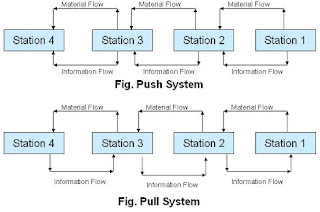


Without taking too much length of the article I will briefly explain Pull and Push System. Lets suppose there are four stations in an assembly line as shown in the fig’s. Station 1 is the first station and feeds material to the second station and so on.

In the pull system, the production schedule is given to the station 1. The station 1 accordingly makes the first component and pushes it to the station 2 and so on. In this way, along with the material flow station 1 is giving the information target also to the station 2, that how many components it needs to make.

In the push system, the production schedule is given to the station 4. the station 4 demands the number of components required from station 3 and so on. In this way the information is passed on from station 4 to station 3, that how many components it needs to make.

The push system is good when the certainty is the system is high, but normally its not so. Normally there is lot of uncertainties like change in demand, machine breakdowns, defective components, etc. This uncertainty leads to building up of inventory at every station. While in the case of pull system, actually the customer is driving the demand, by feeding the information of limited time period to the station 4. This enables the system to be flexible and more responsive to the market demands. The pull system, enforces that if one station is out of order then the whole line will stop example : if station 3 breaks down, then it won’t be able to supply to station 4 and it will stop and it won’t demand anything from station 2 and it will stop. This leads to reduced inventory at every step, which liberates the cost stuck in the inventories.


So, there should be a system that enables the pull system. Here Kanban comes into picture.


How Kanban works?

The simplest method used for Kanban is Dual Kanban. The elements of this system are :

  • Production-ordering Kanban Card
  • Withdrawal Kanban Card
  • Kanban Post

A Production-ordering Kanban - specifies the kind and quantity of product which the preceding process must produce. The one illustrated (right) shows that the machining process SB-8 must produce the crankshaft for the car type SX50BC-150. The crankshaft produced should be placed at store F26-18. The production-ordering Kanban is often called an in-process Kanban or simply a production Kanban.


A Withdrawal Kanban - specifies the kind and quantity of product which a manufacturing process should withdraw from a preceding process. The withdrawal Kanban illustrated (right) shows that the preceding process which makes this part is forging, and the person carrying this Kanban from the subsequent process must go to position B-2 of the forging department to withdraw drive pinions. Each box of drive pinions contains 20 units and the shape of the box is `B'. This Kanban is the 4th of 8 issued. The item back number is an abbreviation of the item.


Kanban Post - Each process (area, cell) on the production line has two Kanban `post-boxes', one for withdrawal and one for production-ordering Kanbans.


Using Kanbans on a production line

At regular intervals a worker takes withdrawal Kanbans that have accumulated in his process post-box, and any empty pallets, to the location where finished parts (components, assemblies) from the preceding process are stored. Each full pallet has attached to it one or more production-ordering Kanbans which he removes and puts in the appropriate post-box belonging to the process that produced the parts. The worker now attaches a withdrawal Kanban to the pallet and takes it back to his own process area. When this new pallet begins to be used, its withdrawal Kanban is put back into the withdrawal post-box. At each process on the line, production-ordering Kanbans are periodically removed from their post-box and used to define what parts and quantities to produce next.


Enablers for Kanban are Quality Assurance and Production Smoothing as can be seen in this fig. If these things are not followed instead of becoming a boon to company Kanban becomes headache. I myself faced this problem when I designed Kanban System in one of the companies I worked for. But the moment I enforced Quality Assurance and Production Smoothing, the Kanban was able to play its meant role. I designed the system so that we are able to avoid the pilferation of material on the assembly lines. The pilferation, lead to inaccurate data punching in ERP software of SAP. The problem was that we were following push system. The worers were getting material more than required for the particular shift. This lead them to neglect the material falling on the shopfloor. The material which fell down was never picked by them, but by sweeper landing it to dustbins. So, actually the ERP was showing that the material of 100 assemblies was there, but it was of only 90. Now this inaccuracy of data, lead to backfire of whole Supply Chain. The stores were not aware that they are not storing enough material to support the production, so they didn’t order to vendors. Vendors didn’t knew that they have to produce this much supply components, so the vendor didn’t plan. But our customer has to be satiated at any cost. So, the result was use of defective parts, stealing parts from other lines, pressurizing vendors to produce more than its capacity. This chain of activities lead to the firefighting in all the related departments like PPC( Production Planning and Control), Production, Purchase, Stores, Vendors and so on. But the core reason was pilferage or push system. So, I proposed this to my company. And fortunately, I was given project to implement it. I studied around eight companies for designing it including Maruti Udyog Limited, Toyota, GE and others. Finally, when we implemented it, the results were simply mind blowing. I never thought that it could be so powerful. My only aim was short sited that is to check material pilferage. But the results were that the inventory of 48 hours on shop floor got reduced to 4 hours, production doubled, manpower was cut by 25 %, production incharge who earlier was always fighting for material on shopfloor didn’t need to go to shop floor for a week. This was one of the major turning point in my life. And I came to understand and appreciate the power of Toyota Production System or Lean Manufacturing and till now directly or indirectly I m pursuing career in it.
I hope the article would be helpful to the readers. Wait for next article of the series by me.

0 comments:

Monday, July 30, 2007

Toyota Production System


Introduction

The credit of developing Toyota Production System goes to Taichi Ohno, former VP, Toyota Motor Corp and Shingo Shigo. Shingo was a thinker, who had the basic framework in his mind, and Ohno was implementer, who actually executed Shingo’s ideas. The system was developed and promoted by them while working for Toyota Motor Corporation. It is being adopted by many Japanese companies in the aftermath of 1973 oil shock. Though the main purpose of the system is to reduce costs, the system also helps increase the capital turnover ratio and improves the productivity of a company as a whole.Even during period of slow growth, the TPS could make a profit by decreasing costs in unique manner that is, by completely eliminating excessive inventory or workforce. It would probably not be overstating our case to say that is another revolutionary production system. It follows the Taylor system (scientific management) and the Ford system (mass assembly line).Basic Idea and FrameworkIts major focus is on completely eliminating unnecessary elements of production system, in order to reduce costs and to increase productivity.However cost reduction is the system’s major goal, but the other three it is ought to satisfy are :
  • Quantity control- this arms the system to effectively deal with the fluctuations in demand.
  • Quality Assurance- this ensures that each process supplies only good part to next process
  • Respect for humanity- the most important element in the system is human being. Happy Worker = Happy Machine = Happy Factory = Happy Company = Increased Profit.

As can be seen in the diagram, the major pillars of this system are JIT and Autonomation. The other two key concepts to the TPS include Flexible Workforce that is multiskilled workforce, and Creative thinking or inventive ideas or capitalizing of worker suggestions.To realize these four concepts, Toyota has established the following systems and methods:

  • Kanban system, which act as enabler for JIT
  • Production smoothing method to adapt to demand changes
  • Reducing Set up time in order to reduce the production lead time
  • Standardization of operations to attain line balancing.
  • Machine Layout and the multi-function worker for the flexible workforce concept
  • Small group improvement activities to reduce the costs and improve the worker’s morale
    Visual control system to achieve Autonomation concept
  • Functional Managements system to promote company wide quality control.

I have myself worked on the few concepts like Kanban, Set up Time reduction, Standardization of operations, Small group improvement activities, Machine Layout, small lot production. I will discuss all the elements of the diagram, in my series of coming articles. My suggestion is just click on the picture to see the full size image and understand the framework.Though while reading this article and seeing the diagram, you may think that this system is only relevant to manufacturing and specifically to assembly line. But, it is nowadays being used even in services and software companies. Only the names are different. Some know it as Lean Manufacturing System. Then most of the companies, while adopting this methodology and customizing it, gives it own name like Maruti calls it MPS ( Maruti Production System) and Subros calls it SPS (Subros Production System).Actually, I came in touch with this methodology in rookie year of my job. I was so fascinated by it, that I kept on bugging my HR and Top Management guys, till they didn’t sent me to actually see it happening in Toyota. And it was, simply mind blowing system. They actually practice, what we read. So, friends that’s all for now, keep reading for my next article on the critical elements of this System.

25 comments: