In micro channel flow the fluid passes through channels of hydraulic diameters in the order of millimeter.currently many people are working on this topic.The need for cooling solutions of small sizes is the main reason for the research in this particular area. Many people have been working on this area since 1980.
it was Tuckerman and pease(1980) who initiated experiments in this area and found deviations from conventional correlations. later WU and Little reported the same discrepancies followed by Choi Et Al ,Yu Et aL,Mala and Li etc.All the results so far quoted were based on experimental work.But in 2004, owahib came up with his experimental investigations that the heat transfer correlations were in accordance with the conventional ones.Then Lee and Garimella (2004) came with some ting new .They conducted NUMERICAL INVESTIGATIONS considering the effects of thermal boundary layers and all.Their numerical investigations were clearly in accordance with the conventional ones.Their work consisted of different cases ,they meticulously took into effect the of thermal and boundary layer . They conducted simulations for all the possible cases and came up with conclusion that the discrepancies which were found were because of the boundary layer effects.In the paper they have published various cases and in each case the numerical investigations were in accordance with the results which were in accordance with work earlier. LEE ,V.Garimella, Khandilekar are few of the people who are working extensively in this area.
To sum up, the micro channel flows and mini channel flows are in accordance with the conventional correlations .one has to be very careful in understanding the type of flow he is dealing with because in cases where flow is not completely developed the Nusselt number would be more than Expected .
Tuesday, October 7, 2008
MICRO CHANNEL FLOW.

Wednesday, February 20, 2008
scram jet design and oblique shock
In scram jets combustion occurs at super sonic air velocities. Oxygen is directly available from air and there is no need for tank to store oxygen. the velocities with which these engines run are very high about 10 -15 times sonic speed.
Intake of air matters a lot in this design . and it is a bit complex .
If the pressures with which air enter s the combustor increases we get high speeds .
In order to achieve high pressures the intake is designed in such a way to increase pressure. The main principle behind it being oblique shock occurrence which causes an increase in pressure and change in direction of flow .
The body of jet is provided with ramps (as shown in figure ) which are responsible for generation of oblique shock waves.the generation of oblique shock occurs at the tip of the ramp .the designing is done in such a way that the shock wave direction after meeting the ramp tips converge at the inlet of the intake of combustor and the flow is also directed towards the intake .
Thursday, February 14, 2008
FUEL INJECTORS
At first, carburetors were replaced with throttle body fuel injection systems. Gradually, as new engines were designed, throttle body fuel injection was replaced by multi-port fuel injection.
Fuel-injection management comprises all the components which are involved in transferring the fuel from the tank and into the combustion chamber:
- The low-pressure pump forces the fuel from the tank into the pressure chamber of the high-pressure pump.
- The high-pressure pump compresses the fuel.
- Mechanically or electronically triggered valves meter the correct amount of compressed fuel to the engine at the correct moment in time.
- The fuel is then injected into the combustion chamber through the nozzles
1997:
First Common Rail system in the world for passenger cars.
Injection pressure: 1,350 bar.
1999:
Common Rail system for trucks.
Injection pressure: 1,400 bar.
2001:
2nd generation Common Rail for passenger cars makes diesel engines even more economical, cleaner, quieter and more powerful. Injection pressure: 1,600 bar.
2002:
2nd generation Common Rail for trucks gives lower emissions, improved fuel consumption and more power.
Injection pressure: 1,600 bar.
2003:
3rd generation Common Rail with rapid-switch piezo inline injectors for cars.
Advantages: up to 20 % lower emissions or up to 5 % more power or up to 3 % lower fuel consumption or up to 3 dB(A) less engine noise.
Injection pressure: 1,600 bar.
Wednesday, October 10, 2007
Mechatronics

Experts are of the opinion that future mechanical,electrical ,computer science and IT have to deal with mechatronics or face the possibility of becoming out dated. Mechatronics are now a days used in manufacture of cars by use of electronic engine management systems ,collision detection,global positioning system etc.Research and development potential in mechatronics includes areas such as space technology, especially in the wake use of robots for space exploration.
Another variant of mechatronics is boimechatronics which is an applied interdisciplinary science that aims to integrate mechanical elements in human body,both for therapeutic uses and for augmentation of existing abilities.is includes aspectsof biology ,mechanics and electronics.
Wednesday, September 19, 2007
OEE-Overall Equipment Effectiveness

- Lets assume that there is a student of Engineering, who has 365 days in the year.
- Out of 365 days lets assume that 100 days are for holidays, as no student should study for 365 days. Then 265 days are left. This is known as Loading Time, while 100 days are known as Not Scheduled Time.
- Now, out of planned 265 days of working, student fells ill for aroun 15 days. Now, this gives us actually 250 days, where the student actually worked, and is known as Running Time. While the 15 days are known as Idle Time.
- Now, lets assume that the student claims that at his efficient or effective state of mind an health he can complete 80 pages of a book per day. So, this can be considered as Theoretical Output that is expected during the Running time. So, in this case it would be 250x80=20000 pages in the year. But, actually we found that he has read only 15000 pages. The reasons could be several that reduced his efficiency and effectivenes. So, 15000 pages, is known as Actual Output.
- Now, at the end of the year, teacher took a test of the student. The test was out of 15000 pages he studied during the year. As, the student has read it effectively and efficiently he should have got 100 marks out of 100. But, he got only 70 marks. Now, whats the reason. It means that out of 15000 pages he read only 70% properly. Other 30% was bad quality reading. So, he read only 10500 pages properly and the 4500 pages not properly. So, 10500 can be said as Good Output.
So, now we will calculate the OEE of student during the considered year. It will be comprised of following elements
- Availability i.e. Running Time/Loading Time or we can say actually followed time table w.r.t. planned time table.
- Speed Efficiency i.e. Actual Output/Theoretical output.
- Quality Efficiency i.e. Good Output/Actual Output.
Or if you notice carefully, in the above diagram we have just calculated Good Output/Loading Time.
Thursday, September 6, 2007
JIT-Jidoka (Autonomation)

Now, how this signal is generated. In the traditional automobile environment, the operator or the authorized person on the defect producing station pulls the hanging rope (above the station). This rope is connected to all the lines. And pulling the rope from any point leads to the shut down of all the connected lines.
The method of generating signal was modified to electronic means, when the rope was replaced by a button available on all the stations. This button, when pressed via common electrical supply shuts down all the connecting production lines. And immediately, the Andon board, with all the stations labeled on it, starts indicating that problem is occurring on a particular station. And recently, with the improvement of Internet and Information Technology this is done by use of sophisticated electronics and software.
This system was enhanced and implemented to an extent, that even the supplier and customer plants were sometimes stopped by the signal.
ONE LAKH CAR CONCEPT

Ratan tata had a dream of substituting two wheelers on road . this developed into emergence of a ONE LAKH CAR CONCEPT, which is said as the chairman’s parting gift to the Indian auto industry.
The criterion was simple, to produce a small car with four doors, cheap to run and conseable to produced in different parts of the country.
Beginning with styling , this car could be said as funky, starting from the zing DNA which was modeled on the smart and looked much like the Daimler Chrysler micro-mini ,the car is now evolved. It sports a sleek, but blunt front end which is reminiscent of the recent of recently launched ZEN ESTILO .
The engine is at the back thus there will be little space behind the back seat and the rear hatch. So luggage space will be premium and be one of the draw backs os the car. The rear hatch will provide access to the engine which will be below the rear seat, the folded over seat presents the luggage carrying option.
It’s a two cylinder engine and 660cc for a petrol engine and 700 engine. The company is planning to launch the petrol engine and later the diesel one.The diesel engine will be two cylinder common rail engine with a specially designed injection system developed by BOSCH for low cost two cylinder engines .Mileage has been reportedly to be 26kmpl in tata internal test and company is trying to increase it to 30. we can expect around 24kmpl on the road .
The two dorrs on the either side are tiny,especially the rear ones. How ever they offer comfortable ingress/egress considering the height of the car. Considering the height of make and rear engine,inside spacing is premium make. One thing is sure, it’s a city car and could be out of place on high ways.
The price is expected to lie between 1.1 -1.25 lakh
Monday, September 3, 2007
MECHANICAL ENGINEERING

A mechanical engineer had ,has and will have a good demand.
Each and every industry begin put up needs a mechanical engineer and its a VAST subject.
This particular branch has many sub divisions ,which may be broadly divided into
1)Heat& thermodynamics.
2)Manufacturing.
3)Machine design.
4)Machines.
HEAT & THERMODYNAMICS
This can be defined as the heart of the mechanical engineering.
This mainly deals with the heat which may be further divided into
a)Refrigeration and Air conditioning, which may be further divided into crogenics (dealing with temperatures below 120k)
b)Combustion :This deals all the combustion processes taking place in engines.
c) Heat transfer:This deals with processes like convection,conduction,radiation which are being used in the development of solar energy concepts,thermal power plant engineering etc.
d)GAS dynamics : This particular area is developing htese days and lot of reasearch is going on these days in computational fluid dynamics.
Manufacturing:
This is another important part of the mechanical engineering mainly dealing with the various conventional and modern methods of producing machine parts and processing techniques.
This you can say is a kind of dry subject where u come across various machines used for producing parts.
In this area the importance is given for developing methods to get parts machined parts with greater surface finish and quality,reducing wastes during producing parts,developing new modern methods for solving the problem of huge waste.
The modern methods include processes of converting one form of energy to another in order ot get parts machined .ex:using water jets,lasers,electron beams etc to remove material.
A lot of research is going on these modern methods which is quite interesting..
Machine design:
In the current world a lot of credit is begin given to manufacture things with grater compactness.This is what is begin dealt in this part.
this has huge huge demand ,like designing of cars of very small size.
This mainly deals with the designing of parts to work under particular constraints, taking decisions like which material can be used to replace a particular material for many reasons like weight constraint,thermal behavior etc.
To conclude this is a very interesting area with a lot of thing to be explored
Machines:
This part may be said to contain many things which we can see in daily life having greater usage and importance like automobiles,fans,turbines etc.
This part will provide you with the basic concepts and working principles of the machines.This one too is an interesting area with a lot to be explored.
Wednesday, August 29, 2007
Design Engineer-Careers in Mechanical Engineering

Saturday, August 18, 2007
Careers in Mechanical Engineering

This is my first article on the series. The series will be dedicated to the career options for engineers in the field of Mechanical Engineering.
Profile No. 1
Production Engineer
Well I am writing this on the basis of my experience as Production Engineer in Subros Ltd and Philips Electronics India Ltd
The role is of handling Production lines anywhere like in the field of Automobiles one handles assembly lines, machining lines, heat treatment lines, sheet metal lines, tube bending lines, etc.
The career path is normally a fresher is hired ( campus or off campus) as GET( Graduate Engineer Trainee). And the first few months goes to get accustomed to machinery. Especially in Japanese companies, it is ensured that engineers are trained to handle machines themselves. Then the Engineer comes into role of coordination. This includes, to delegate and monitor tasks of operators as per the scheducle given by PPC ( Production Planning & Control). Then to coordinate with Maintenance Deptt, Quality Deptt, Stores Deptt, Purchase Deptt, HR deptt and virtually every department.
This is most critical profile in production based companies, because here is the actual operations are conducted, others are support functions.
The issues one has to deal with are :
- Material Shortages
- Machine Failure
- Bad Quality
- Audits
- Thefts
- Absentism
- Union Problems
- Accidents
- Production Targets Failure
- Overtime
But, as the pressure is high so are the rewards. Production Engineers gets maximum increments and faster growth. Normally these are the people, who become Plant Heads, Operations Head and finally CEO's
The package starts in SME's is around 1.8 lac/annum and grows to 5 in next 3 years. After that it depends on the person's performance and the career path he has created for himself. Apart from money, this is the field for leaders, who have dominant and assertive personalities. They work like generals of army in the field.
My suggestion to everyone who wants to build career in Mechanical Engineering is spend at least 6 months in Production Department. The learning will be actual operations, around which the whole company revolves. So, once a person has been through this experience, he can work in any department keeping the actual situations in mind.
It will be good, if you read this article then comment on it. It will motivate me to write more in the series.
Thursday, August 16, 2007
Kanban
This is my second article of the series of Toyota Production System on this blog. I m not making it very elaborate and cumbersome. For more details there is lot of literature available on the net. My only objective in writing this article is to give the jist of the methodology and to share my experiences with the readers.
What is Kanban?
Kanban is a critical element of Toyota Production System, by acting as enabler to JIT. It was developed in Toyota Motor Corporation in Japan during 1950’s. Now it is a very popular tool in lean manufacturing.
Essentially, the most important role Kanban plays by enforcing and checking Pull System in manufacturing. Literal meaning of Kanban comes from Kan- card, Ban- signal. So, it’s a information system employing cards that enables and checks the usage of Pull System.
Pull & Push System
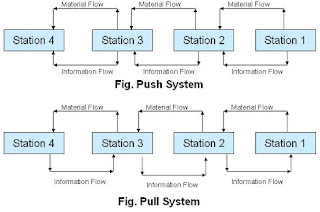
Without taking too much length of the article I will briefly explain Pull and Push System. Lets suppose there are four stations in an assembly line as shown in the fig’s. Station 1 is the first station and feeds material to the second station and so on.
In the pull system, the production schedule is given to the station 1. The station 1 accordingly makes the first component and pushes it to the station 2 and so on. In this way, along with the material flow station 1 is giving the information target also to the station 2, that how many components it needs to make.
In the push system, the production schedule is given to the station 4. the station 4 demands the number of components required from station 3 and so on. In this way the information is passed on from station 4 to station 3, that how many components it needs to make.
The push system is good when the certainty is the system is high, but normally its not so. Normally there is lot of uncertainties like change in demand, machine breakdowns, defective components, etc. This uncertainty leads to building up of inventory at every station. While in the case of pull system, actually the customer is driving the demand, by feeding the information of limited time period to the station 4. This enables the system to be flexible and more responsive to the market demands. The pull system, enforces that if one station is out of order then the whole line will stop example : if station 3 breaks down, then it won’t be able to supply to station 4 and it will stop and it won’t demand anything from station 2 and it will stop. This leads to reduced inventory at every step, which liberates the cost stuck in the inventories.
So, there should be a system that enables the pull system. Here Kanban comes into picture.
How Kanban works?
The simplest method used for Kanban is Dual Kanban. The elements of this system are :
- Production-ordering Kanban Card
- Withdrawal Kanban Card
- Kanban Post
A Production-ordering Kanban - specifies the kind and quantity of product which the preceding process must produce. The one illustrated (right) shows that the machining process SB-8 must produce the crankshaft for the car type SX50BC-150. The crankshaft produced should be placed at store F26-18. The production-ordering Kanban is often called an in-process Kanban or simply a production Kanban.

A Withdrawal Kanban - specifies the kind and quantity of product which a manufacturing process should withdraw from a preceding process. The withdrawal Kanban illustrated (right) shows that the preceding process which makes this part is forging, and the person carrying this Kanban from the subsequent process must go to position B-2 of the forging department to withdraw drive pinions. Each box of drive pinions contains 20 units and the shape of the box is `B'. This Kanban is the 4th of 8 issued. The item back number is an abbreviation of the item.

Kanban Post - Each process (area, cell) on the production line has two Kanban `post-boxes', one for withdrawal and one for production-ordering Kanbans.
Using Kanbans on a production line
At regular intervals a worker takes withdrawal Kanbans that have accumulated in his process post-box, and any empty pallets, to the location where finished parts (components, assemblies) from the preceding process are stored. Each full pallet has attached to it one or more production-ordering Kanbans which he removes and puts in the appropriate post-box belonging to the process that produced the parts. The worker now attaches a withdrawal Kanban to the pallet and takes it back to his own process area. When this new pallet begins to be used, its withdrawal Kanban is put back into the withdrawal post-box. At each process on the line, production-ordering Kanbans are periodically removed from their post-box and used to define what parts and quantities to produce next.
Enablers for Kanban are Quality Assurance and Production Smoothing as can be seen in this fig. If these things are not followed instead of becoming a boon to company Kanban becomes headache. I myself faced this problem when I designed Kanban System in one of the companies I worked for. But the moment I enforced Quality Assurance and Production Smoothing, the Kanban was able to play its meant role. I designed the system so that we are able to avoid the pilferation of material on the assembly lines. The pilferation, lead to inaccurate data punching in ERP software of SAP. The problem was that we were following push system. The worers were getting material more than required for the particular shift. This lead them to neglect the material falling on the shopfloor. The material which fell down was never picked by them, but by sweeper landing it to dustbins. So, actually the ERP was showing that the material of 100 assemblies was there, but it was of only 90. Now this inaccuracy of data, lead to backfire of whole Supply Chain. The stores were not aware that they are not storing enough material to support the production, so they didn’t order to vendors. Vendors didn’t knew that they have to produce this much supply components, so the vendor didn’t plan. But our customer has to be satiated at any cost. So, the result was use of defective parts, stealing parts from other lines, pressurizing vendors to produce more than its capacity. This chain of activities lead to the firefighting in all the related departments like PPC( Production Planning and Control), Production, Purchase, Stores, Vendors and so on. But the core reason was pilferage or push system. So, I proposed this to my company. And fortunately, I was given project to implement it. I studied around eight companies for designing it including Maruti Udyog Limited, Toyota, GE and others. Finally, when we implemented it, the results were simply mind blowing. I never thought that it could be so powerful. My only aim was short sited that is to check material pilferage. But the results were that the inventory of 48 hours on shop floor got reduced to 4 hours, production doubled, manpower was cut by 25 %, production incharge who earlier was always fighting for material on shopfloor didn’t need to go to shop floor for a week. This was one of the major turning point in my life. And I came to understand and appreciate the power of Toyota Production System or Lean Manufacturing and till now directly or indirectly I m pursuing career in it.
I hope the article would be helpful to the readers. Wait for next article of the series by me.
Monday, July 30, 2007
Toyota Production System

The credit of developing Toyota Production System goes to Taichi Ohno, former VP, Toyota Motor Corp and Shingo Shigo. Shingo was a thinker, who had the basic framework in his mind, and Ohno was implementer, who actually executed Shingo’s ideas. The system was developed and promoted by them while working for Toyota Motor Corporation. It is being adopted by many Japanese companies in the aftermath of 1973 oil shock. Though the main purpose of the system is to reduce costs, the system also helps increase the capital turnover ratio and improves the productivity of a company as a whole.Even during period of slow growth, the TPS could make a profit by decreasing costs in unique manner that is, by completely eliminating excessive inventory or workforce. It would probably not be overstating our case to say that is another revolutionary production system. It follows the Taylor system (scientific management) and the Ford system (mass assembly line).Basic Idea and FrameworkIts major focus is on completely eliminating unnecessary elements of production system, in order to reduce costs and to increase productivity.However cost reduction is the system’s major goal, but the other three it is ought to satisfy are :
- Quantity control- this arms the system to effectively deal with the fluctuations in demand.
- Quality Assurance- this ensures that each process supplies only good part to next process
- Respect for humanity- the most important element in the system is human being. Happy Worker = Happy Machine = Happy Factory = Happy Company = Increased Profit.
As can be seen in the diagram, the major pillars of this system are JIT and Autonomation. The other two key concepts to the TPS include Flexible Workforce that is multiskilled workforce, and Creative thinking or inventive ideas or capitalizing of worker suggestions.To realize these four concepts, Toyota has established the following systems and methods:
- Kanban system, which act as enabler for JIT
- Production smoothing method to adapt to demand changes
- Reducing Set up time in order to reduce the production lead time
- Standardization of operations to attain line balancing.
- Machine Layout and the multi-function worker for the flexible workforce concept
- Small group improvement activities to reduce the costs and improve the worker’s morale
Visual control system to achieve Autonomation concept - Functional Managements system to promote company wide quality control.
I have myself worked on the few concepts like Kanban, Set up Time reduction, Standardization of operations, Small group improvement activities, Machine Layout, small lot production. I will discuss all the elements of the diagram, in my series of coming articles. My suggestion is just click on the picture to see the full size image and understand the framework.Though while reading this article and seeing the diagram, you may think that this system is only relevant to manufacturing and specifically to assembly line. But, it is nowadays being used even in services and software companies. Only the names are different. Some know it as Lean Manufacturing System. Then most of the companies, while adopting this methodology and customizing it, gives it own name like Maruti calls it MPS ( Maruti Production System) and Subros calls it SPS (Subros Production System).Actually, I came in touch with this methodology in rookie year of my job. I was so fascinated by it, that I kept on bugging my HR and Top Management guys, till they didn’t sent me to actually see it happening in Toyota. And it was, simply mind blowing system. They actually practice, what we read. So, friends that’s all for now, keep reading for my next article on the critical elements of this System.


2 comments:
Post a Comment